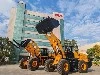
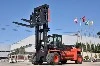
When it comes to forklifts moving heavy loads, people might focus on engine power and lifting capacity. However, actually stopping tens of tons of cargo smoothly at the work site is equally important.
When starting the equipment, you need to overcome the stationary state of the entire vehicle and the cargo; while moving, the entire vehicle has already developed inertia. Especially when fully loaded, the weight of the cargo and the vehicle itself is combined, so braking requires controlling not only the vehicle but a larger motion system.
Therefore, "being able to pull" is only the first step; "being able to stop smoothly" is equally important.
1.The greater the weight, the more pronounced the inertia.
When a forklift is fully loaded, the overall mass of the vehicle increases significantly.
Once the vehicle starts moving, even if you release the accelerator pedal, it won't stop immediately. The braking system needs to gradually reduce the vehicle's speed, while the cargo itself will continue its original motion trend due to inertia.
This is why the braking feel is different when the forklift is empty and fully loaded at the same speed. The heavier the load, the less you can simply judge the braking distance using the same operating methods as when the vehicle is empty.
2."Stopping" is not just about stopping the wheels.
True heavy-duty handling requires both the vehicle and the load to stabilize together.
If braking is too abrupt, the vehicle may decelerate quickly, but the load may be thrown out due to inertia; if braking is too late, insufficient braking distance may occur.
Therefore, the braking design of heavy-duty equipment must strike a balance between braking force, tire grip, vehicle stability, and the condition of the load. This is a significant difference in user experience between heavy-duty forklifts and light-duty vehicles.
3.Road conditions also change the difficulty of "stopping."
The same equipment can perform completely differently on different road surfaces.
On smooth, dry, hardened surfaces, the tires provide relatively stable grip; however, if encountering:
wet surfaces
gravel surfaces
muddy surfaces
slopes
uneven surfaces
the vehicle needs to be decelerated more carefully.
Especially when going downhill fully loaded, the vehicle is affected by the slope and inertia, further increasing the pressure on the braking system.
4.Why should you never make sudden turns or brakes when fully loaded?
Sudden turns and brakes are inherently dangerous operations, and should be strictly prohibited even when unloaded. The risks are amplified exponentially under full load.
In heavy-duty operations, sudden braking and sudden turns often occur simultaneously. For example, suddenly applying the brakes while turning causes an instantaneous change in the vehicle's motion, resulting in significant cargo swaying and easily leading to skidding, cargo tipping, and in severe cases, complete vehicle instability.
The proper operating procedure should follow: slow down in advance → drive smoothly and at a constant speed → brake gently → confirm that the vehicle and cargo are completely stable before proceeding to the next step.
5.Why is the braking system even more important for heavy-duty forklifts?
When equipment needs to handle heavy loads such as steel, stone, and machinery for extended periods, the braking system is not dealing with a single stop, but rather frequent starts, starts, stops, and starts.
Therefore, the vehicle's braking system needs to be matched to the overall weight of the vehicle, tires, drive axle, and the actual operating environment.
In other words, building a heavy-duty forklift isn't simply about making the engine bigger and the forks thicker. From the powertrain and transmission to the axles, brakes, tires, and frame, every system needs to be matched to heavy-duty operations.
The real test of equipment in heavy-duty handling isn't just its ability to "lift," but also its ability to "transport steadily and stop safely."
Especially for heavy-duty forklifts, the vehicle's braking performance, tire grip, overall structure, and the driver's operating style all directly affect the stability during heavy-duty transport. Instead of waiting until an emergency stop is needed to consider braking capabilities, it's better to leave sufficient safety margins for the vehicle from the beginning of equipment configuration and operational planning.