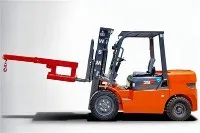
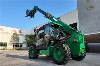
Telehandlers generally come in two common configurations: fixed and rotating. On fixed telehandlers, the cab and boom are mounted directly to the chassis. To change the working direction, the entire machine needs to move or turn. On rotating telehandlers, the upper structure can rotate 360 degrees around the chassis, allowing the operator to change the working direction without moving the machine.
This design mainly addresses the needs of material handling in multiple directions and is one of the key structural differences between rotating and fixed telehandlers.

1. How Does the Upper Structure Rotate?
A rotating telehandler uses a slewing bearing between the upper structure and the chassis to connect the two sections. Driven by the rotation mechanism, the upper structure turns around its central axis.
The cab, boom and other working components are mounted on the upper structure, so they rotate together while the chassis and wheels remain stationary. This means operators do not need to move or turn the entire machine frequently. Once the machine is in position, materials can be handled in different directions around it.
2. How Does 360-Degree Rotation Affect Material Handling?
In many work areas, materials are stored in one location but need to be delivered in another direction. For example, a machine may be parked beside a building while materials need to be moved to a work area on the side.
With a fixed telehandler, the entire machine needs to be repositioned to face the target area. With a rotating telehandler, the operator can simply rotate the upper structure and use the boom's extension and lifting functions to move the materials.
In confined spaces with walls, other equipment or obstacles nearby, rotating in place can reduce the need for frequent machine repositioning. However, the working range is still limited by boom length, lifting height, load capacity and available space on site. Actual operating conditions must be taken into account.
3. Why Do Rotating Telehandlers Need Outriggers and a Load Moment Limiter?
When the upper structure rotates, the position of the boom and load changes, affecting the machine's load distribution. This is particularly important when the boom is extended or raised to a greater height, as the machine requires adequate support and stability.
Rotating telehandlers are therefore commonly equipped with hydraulic outriggers. During operation, the outriggers are extended and positioned on the ground as required by the machine, increasing the support area and helping maintain stability.
A load moment limiter can also monitor the boom's operating conditions and work with the load chart to limit the permitted load at different boom lengths, angles and working directions. However, 360-degree rotation does not mean the machine has the same rated lifting capacity in every direction. Operators must follow the corresponding load limits during operation.
The design of in-place rotation reflects the move towards more compact and efficient machinery. Combined with intelligent control systems, it can further improve the machine's operating capabilities.