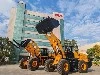
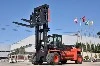
In stone quarries and processing facilities, both wheel loaders and stone handlers serve as primary pieces of equipment for material handling. While they may look quite similar, they differ in terms of their front-end working attachments and the specific tasks they are designed to perform.
1. Differences in Front-End Working Attachments
Wheel loaders are equipped with a bucket, which is inherently designed for scooping and loading loose materials; while they can occasionally be used to move stone, it is not their primary function. During operation, the bucket cuts into the base of the material, and the lift arms raise it for loading or unloading. Although a bucket can handle small, scattered pieces of stone, that is not where its true strength lies.
Stone handlers, by contrast, are equipped with forks and feature a dual-arm linkage structure. They are primarily designed to handle large, heavy blocks of stone. The forks are inserted beneath a stone block, allowing it to be lifted and transported. Since stone blocks vary in size and shape, the forks are typically selected based on the dimensions and weight of the blocks being moved.
2. Differences in the Types of Stone Handled
Materials handled in stone facilities generally fall into two categories: loose materials-such as crushed stone or debris resulting from extraction and cutting-and large, unprocessed stone blocks.
A wheel loader's bucket is highly effective for managing loose materials, such as gathering and loading crushed stone or debris after extraction.
A stone handler's forks are better suited for large, relatively regular-shaped stone blocks. These blocks are heavy and valuable, requiring careful handling to avoid damage. Using a bucket to transport such blocks often leads to slippage or the chipping of edges. When moving, loading, or stacking stone blocks, the fork-lifting method provides a more stable support, better preserving the integrity of the stone. Consequently, this is the most common method for transporting stone blocks.
In a real-world operational environment, these two machines function more as partners than as competing alternatives. A complete extraction operation requires a well-coordinated equipment setup: wheel loaders are used to clear debris, level the site, and transport crushed stone, ensuring the work area remains accessible; meanwhile, block handlers (fork-lift loaders) are tasked with stacking, relocating, and loading large stone blocks, moving raw material to storage yards or processing workshops.
Therefore, selecting the right equipment goes beyond simply asking, "Can it move stone?" Instead, one must consider the primary material being handled: if the work consists mainly of clearing debris and transporting loose crushed stone, a wheel loader is the better choice; if the operation involves frequent handling and stacking of large stone blocks, a block handler is required. While some sites may use a single machine equipped with various attachments to perform multiple roles, this is only a suitable stopgap for occasional, emergency needs. For long-term, consistent operations, specialized equipment offers higher efficiency and lower risk. Understanding the distinct roles of these machines allows for an optimal equipment mix-one that balances operational efficiency with the proper protection of the stone material.