In warehouses, workshops, and logistics centers, the short-distance movement of palletized goods is an integral part of processes such as receiving, sorting, and supplying production lines.
Beyond standard forklifts, electric pallet jacks are another common piece of material handling equipment. Primarily designed for the horizontal transport of palletized goods, they feature electric propulsion and a hydraulic system for lifting the forks. Their structural design and operational method differ from those of conventional counterbalanced forklifts.
So, how do electric pallet jacks work? What are their structural characteristics and typical application scenarios?
I. How Do Electric Pallet Jacks Work?
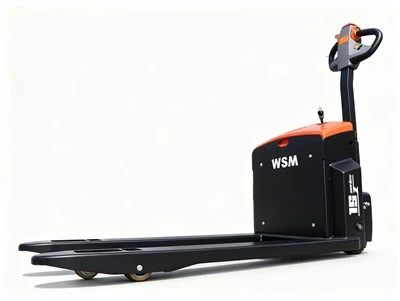
An electric pallet jack consists primarily of a chassis, forks, a drive system, and a hydraulic lifting system.
The operation is straightforward: the operator uses a handle to maneuver the unit, inserting the forks beneath a pallet. A hydraulic system then raises the forks to the necessary height, lifting the pallet off the ground. The drive motor propels the unit forward, facilitating the transport of the goods.
Unlike forklifts that utilize a mast for high-level lifting, standard electric pallet jacks offer a limited lifting range-typically just ten to several dozen centimeters-sufficient to clear the floor for horizontal transport.
II. Common Application Scenarios for Electric Pallet Jacks
Electric pallet jacks are primarily used for moving palletized goods and are widely employed across warehousing, logistics, and manufacturing sectors.
1. Warehouse Inventory Handling
Whether dealing with newly arrived stock or items picked and ready for dispatch, warehouses frequently require the repositioning of pallets. Electric pallet jacks are particularly well-suited for tasks involving frequent movement or longer transit distances within a facility, as their electric drive reduces physical strain and makes operation much easier.
2. Material Distribution in Production Workshops
On production lines, the replenishment of raw materials, components, and semi-finished goods often occurs with high frequency and along relatively fixed routes. In such environments, manual handling or the use of non-powered (manual) pallet jacks is often inefficient. Electric pallet jacks are powered by an electric drive, making them effortless to operate. They are well-suited for tasks requiring frequent movement over longer distances-such as delivering materials to specific workstations on schedule-thereby reducing the physical strain on operators.
3. Logistics Sorting and Outbound Operations
In logistics centers, goods that have been sorted and packed are placed onto pallets and then transported to a staging area or loading dock. This type of pallet handling is another common application for electric pallet jacks.
III. What is the difference between walk-behind and stand-on electric pallet jacks?
Different operational environments have varying requirements, which has led to the development of several operating configurations for electric pallet jacks. Common types include walk-behind, stand-on, and side-stance models. Walk-behind and stand-on versions are the most prevalent; the distinction between them lies not only in where the operator stands, but also in the transport distances and operational rhythms for which they are best suited.
Walk-behind Electric Pallet Jacks
Walk-behind models do not feature a dedicated standing platform; instead, the operator walks behind the unit while controlling it to move goods. These units have a compact design and offer excellent maneuverability, making them ideal for short-distance transport in confined spaces. They are best suited for tasks involving frequent stops over distances of less than 30 meters-such as operations in small warehouses, retail backrooms, narrow aisles, or inside elevators.

Stand-on Electric Pallet Jacks
Stand-on models are equipped with a dedicated platform, allowing the operator to stand on the vehicle while controlling it via a handle. These models typically include safety features such as protective side arms, and some versions may also include a backrest. Compared to walk-behind units, they reduce the physical exertion associated with walking long distances. They are well-suited for continuous, high-frequency transport over distances of approximately 30 to 100 meters-for example, moving goods across different zones in a medium-sized warehouse, connecting production lines in a workshop, or handling items within a sorting center.
The difference between these two types goes beyond where the operator stands; it fundamentally relates to the operational rhythm for which each is designed. The choice depends on factors such as the transport distance, frequency of movement, and the conditions of the aisles or pathways at the site.
From diesel and electric forklifts to rough-terrain forklifts-and the electric pallet trucks featured in this installment-each type of handling equipment possesses unique structural designs and operational methods, tailored to specific material-handling requirements.
Although electric pallet trucks are primarily used for short-distance horizontal transport, they remain an indispensable piece of equipment in modern warehousing and logistics operations.