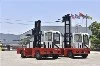
In warehouses, factories, and logistics transfer sites, forklifts perform a large number of repetitive handling tasks daily. Actions such as picking up goods, turning, and stacking all rely on the driver's accurate judgment of the goods' position, vehicle distance, and the surrounding environment. Therefore, the driver's field of vision determines whether they can complete operations quickly and safely.
For forklifts, the driver's field of vision is not simply about "seeing far." It requires accurately acquiring information about the fork position, goods' condition, and the surrounding environment under different operating conditions. In high-frequency handling, narrow aisles, or heavy-duty operating environments, a good field of vision design helps drivers reduce operational errors and improve overall operational efficiency.
What factors affect driver visibility during forklift operations?
When handling goods, the mast and forks, located in front of the driver, are among the most important structures affecting visibility. When picking up tall goods or handling large goods, the goods themselves may obstruct part of the area in front, requiring the driver to adjust the vehicle angle or use auxiliary observations to complete precise operations.
Furthermore, forklift operating environments are often quite complex. Warehouse racks, production equipment, other vehicles, and on-site personnel all affect the driver's judgment. Therefore, forklifts not only need to meet basic load-bearing and movement requirements but also need a well-designed structure to provide the driver with clearer operational information.
How does the mast structure affect forward visibility?
The mast is a crucial component for forklifts to perform lifting operations and is a key factor affecting the driver's field of vision.
During the design process, the mast needs not only sufficient strength and stability but also consideration for the driver's observation needs. A reasonable structural layout can reduce obstruction of the forward view, making it easier for the driver to judge the positional relationship between the forks and the goods.
Especially in stacking operations, the driver needs to precisely control the position of the forks entering the pallet. If the forward visibility is limited, it may require more adjustments, affecting not only work efficiency but also increasing operational difficulty.
Therefore, modern forklift design increasingly emphasizes the coordination between mast structure, driving position, and operating perspective.
Cabin design is evolving towards greater comfort and intuitiveness.
Cabin design also affects the operating experience.
A spacious driving area, a more ergonomic seat position, and an optimized control layout all allow the driver to maintain a more natural operating posture. During long, continuous operation, these designs reduce operator fatigue, allowing drivers to focus more on the work process. More and more forklifts are adopting improved glass visibility designs, expanding the field of view and enabling drivers to have a more intuitive understanding of the equipment's surroundings.
For logistics centers, manufacturing plants, and outdoor work environments requiring long-term operation, the cab is no longer just an operating space, but also a crucial factor affecting work efficiency.
Future forklift design will place greater emphasis on the coordination between humans and equipment.
The development direction of forklifts is gradually shifting from simply increasing load capacity to improving the overall user experience.
A forklift suitable for long-term operation needs not only a reliable power system and a stable structure, but also the ability for the driver to operate it more easily and accurately.
For businesses, when choosing a forklift, in addition to considering basic parameters such as rated load and work efficiency, it is also necessary to consider the actual working environment and whether the equipment can help operators complete daily handling tasks more efficiently.