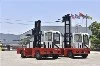
In large stone quarries and mining operations, handling raw stone blocks is not simply a matter of lifting capacity. A machine needs to move heavy blocks across uneven ground, position them accurately, and keep the load under control during lifting and transport.
As block sizes increase, conventional forklifts or smaller loaders may no longer provide enough capacity or stability. This is where 50-ton class fork-loaders come into play. Their design focuses on three things: carrying heavy loads safely, maintaining control on rough ground, and reducing unnecessary handling of valuable stone.
1. The Structure Has to Handle the Load First
For a machine working with loads of up to 50 tons, the main structure takes much higher loads than a conventional forklift or wheel loader.
The frame and other load-bearing components therefore use high-strength steel and reinforced structural sections. A heavy-duty box-section frame helps the machine withstand bending and twisting when carrying a large stone block over uneven quarry surfaces.
The lifting mechanism is another important part. An eight-linkage lifting system provides the force needed for lifting and prying heavy blocks, while reinforced drive axles are designed to cope with the additional loads transferred through the wheels and drivetrain.
Weight distribution also matters. The wheelbase, frame structure and counterweight are matched to the expected load so that the machine remains properly balanced while lifting and moving a large block. This becomes particularly important when the load is raised or when the machine is operating on uneven ground.
2. Heavy Lifting Still Requires Controlled Movement
A 50-ton machine needs more than a powerful engine. When handling natural stone, excessive movement or sudden hydraulic action can damage the material or make positioning difficult.
The powertrain and hydraulic system are therefore designed to provide the pulling and lifting force required under heavy loads. This is useful when the machine needs to climb a slope, approach a block, or carry out a prying operation at the quarry face.
Hydraulic control is equally important during positioning. When a large stone block needs to be placed on the ground, stacked, or loaded for transport, smooth lifting and lowering make it easier for the operator to control the load and reduce unnecessary impact.
Heat management is another consideration in heavy-duty operation. Long working cycles, high hydraulic loads and hot quarry environments can place additional stress on the powertrain and hydraulic system. An independent cooling system helps control engine coolant and hydraulic oil temperatures during extended operation.
3. Where Does a 50-Ton Fork-Loader Actually Help?
The main advantage becomes clearer when looking at the complete handling process.
- Fewer handling steps can mean less risk of stone damage.
Large blocks can sometimes be moved with multiple smaller machines or through several handling stages. However, different lifting points and uneven loading between machines can increase the risk of chipping or cracking the stone.
A 50-ton class machine can handle the block as a single load when the working conditions and load chart permit it. This reduces the number of times the material needs to be repositioned.
- One machine can also cover several stages of the operation.
With different attachments, the machine can be used for tasks such as block handling, yard transfer, stacking and loading. Forks can be used for lifting and moving blocks, while other attachments can be selected for different material-handling requirements.
This makes the equipment useful beyond the quarry face. After extraction, stone blocks still need to be moved around storage yards, positioned for processing, or prepared for loading and transportation.
- Maintenance access is also important for machines working long hours.
A side-opening engine hood provides wider access to the engine compartment, making routine inspections and maintenance work easier. For equipment operating in dusty quarry environments, easier access can be useful when checking filters, fluids, cooling components and other service points.
Handling 50-ton stone blocks places very different demands on equipment compared with ordinary material handling. The machine needs sufficient structural strength, a suitable powertrain, controlled hydraulics and a stable load distribution system.
For large quarries and heavy-duty stone yards, a 50-ton class fork-loader can reduce repeated handling and provide a single-machine solution for moving, stacking and loading oversized stone blocks. Its value is not simply the number "50 tons" on the specification sheet, but how that capacity is converted into controlled and repeatable work in actual quarry conditions.