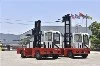
Today, the adoption of electric equipment is rapidly expanding across the logistics, warehousing, and industrial material handling sectors. Lightweight, zero-emission, and quiet electric forklifts-valued for their energy efficiency, environmental friendliness, ease of maintenance, and cost-effectiveness-have become standard equipment for many enterprises, particularly in indoor factory operations and light-load handling tasks.
Many naturally assume that diesel forklifts will eventually be completely replaced and gradually phased out of the market.
However, a look at mines, large construction sites, port yards, heavy industrial plants, and outdoor sites operating in low temperatures reveals a noteworthy reality: despite the growing popularity of electric forklifts, diesel forklifts remain the primary workhorses for heavy-duty, high-intensity, and all-weather operations.
Amidst the wave of electrification, why do diesel forklifts retain their stronghold in heavy-duty applications and continue to shoulder the burden of industrial heavy-load handling? The answer is not "technological obsolescence," but rather their superior suitability, operational stability, and all-weather performance capabilities in specific working conditions.


I. Mismatched Scenarios: Electric Forklifts Suit Light Loads, While Heavy-Duty Conditions Pose Challenges
The core strengths of electric forklifts lie in indoor environments, smooth surfaces, small-to-medium tonnage capacities, and intermittent operation. For routine warehouse cargo turnover, supermarket logistics sorting, and short-distance indoor factory transport, 2-ton and 3-ton electric forklifts handle the job with ease; they offer low energy consumption, zero exhaust emissions, and hassle-free maintenance, providing a distinct user experience.
In contrast, heavy-duty industrial scenarios impose entirely different requirements on handling equipment. Port container transfers, the handling of steel and stone materials, mine loading and unloading, and large-scale infrastructure construction typically require high-capacity forklifts-ranging from 16 to 25 tons or more-often operating in complex and harsh environments. At present, high-tonnage electric forklifts face limitations in certain scenarios: their heavy batteries and bulky overall structure restrict site adaptability. They experience noticeable power degradation during sustained high-output operation and lack sufficient capability for hill climbing, towing, and starting under heavy loads; when navigating uneven surfaces, ramps, or bumpy conditions with heavy loads, issues such as insufficient power, stuttering, or shutdowns due to overload protection may occur.
In contrast, diesel forklifts leverage the characteristics of internal combustion engines-delivering high torque, strong explosive power, and consistent performance without power fade. They provide stable, immediate power output for starting, climbing, and towing heavy loads. Whether handling steel, machinery, or containers weighing several tons, they can lift and transport materials smoothly and effortlessly, effectively meeting the core demands of heavy-duty operations.
II. Operational Freedom: Direct Refueling for Continuous, High-Intensity Work
Heavy-duty industrial scenarios demand high operational continuity. Ports, mines, and large factories often operate around the clock using two- or three-shift systems; even an hour of equipment downtime translates to stalled production, increased costs, and delayed orders.
This presents a major challenge for electric forklifts in continuous heavy-duty operations. Even with high-capacity lithium batteries, operating continuously under heavy loads affects runtime; high-intensity, full-load operation causes the battery life to drop significantly. Once the battery is depleted, it requires a period of downtime for charging-preventing immediate energy replenishment-which can disrupt production or logistics lines and impact overall operational efficiency.
Diesel forklifts offer a more direct method of refueling. A full tank restores them to peak performance in just minutes, eliminating the need for long waits and enabling all-weather, uninterrupted, high-intensity operation. For heavy-duty industrial settings that prioritize stable output and zero downtime, this ability to refuel instantly and operate without stopping represents a hurdle that current electric forklifts cannot overcome. This rapid refueling capability is a standout feature of diesel forklifts.
III. All-Weather Durability: Diesel Forklifts Excel in Harsh Operating Conditions
Electric forklifts are best suited for standardized indoor environments-clean, flat, and temperature-controlled-as they have specific requirements regarding temperature, ground conditions, and operating environments. Cold weather significantly reduces battery activity, directly leading to shorter runtimes and a sharp drop in power output. Furthermore, exposure to dust, rain, mud, and rough terrain can damage batteries, circuits, and electronic control systems, resulting in higher failure rates and a shortened service life.
In contrast, real-world heavy-load handling often takes place in harsh environments characterized by heavy dust, temperature extremes, muddy and rugged terrain, and exposure to the elements-including scorching sun, rain, snow, and wind.
Diesel forklifts are renowned for their ruggedness and durability. They feature a simple, robust structure with fewer electronic control systems, resulting in fewer potential points of failure. Whether operating in the bitter cold of -20°C to -30°C, the scorching heat of 40°C to 50°C, on muddy, pothole-ridden construction sites, or in dust-filled mines, diesel forklifts deliver stable power with minimal limitations imposed by ambient temperature or site conditions.
In heavy-industry scenarios demanding high equipment stability and reliability, diesel forklifts offer unique value thanks to their adaptability, resilience, and ability to operate reliably around the clock.
IV. Real-World Costs for Heavy-Duty Operations: The Cost-Effectiveness of Diesel Forklifts in High-Tonnage Scenarios
Many people hold the preconceived notion that electric forklifts are more cost-effective; however, this conclusion generally applies to small-to-medium tonnage, light-load indoor operations. Heavy-duty scenarios require a more nuanced analysis.
While small-tonnage electric forklifts offer low purchase costs, energy savings, and simple maintenance-making them highly cost-effective in the long run-the situation differs for high-tonnage models (16, 20, or 30 tons and above). These require large-capacity lithium batteries, high-power electronic control systems, and reinforced motors, resulting in purchase prices that far exceed those of equivalent diesel forklifts.
Additionally, high-tonnage batteries entail significant depreciation and replacement costs; once a battery degrades or ages, the replacement expense can rival the cost of half a new vehicle. Furthermore, in complex operating environments, electric forklifts may experience higher failure rates in circuits, motors, and control systems, necessitating consideration of maintenance costs and losses due to downtime. Diesel forklifts feature mature, stable technology, high parts interchangeability, simple and affordable maintenance, and slow depreciation. Although the cost of fuel per use is higher than that of electricity, when factoring in purchase price, maintenance costs, the absence of expensive battery replacements, and zero downtime losses, diesel forklifts actually offer superior overall cost-effectiveness for long-term, heavy-load, and high-intensity operations.
V. It is not that electrification is obsolete, but rather that different scenarios have their own strengths.
We have never denied that the electrification of forklifts is the prevailing industry trend; electric forklifts-characterized by low-carbon eco-friendliness, smart efficiency, quiet operation, and energy savings-represent the optimal solution for standardized warehousing, indoor logistics, and light industrial settings, as well as the inevitable direction for the green upgrading of the industry.
However, a prevailing trend does not imply omnipotence, nor does it mean total replacement.
Electric forklifts excel in "lightweight design, standardization, and green energy efficiency," whereas diesel forklifts win on "high power, stability, all-weather capability, and strong adaptability." While the gradual reduction of diesel forklifts in light-load scenarios is an industry trend, they remain vital core equipment in heavy-load, outdoor, high-intensity, and harsh operating environments thanks to their robust performance capabilities.
Electrification represents the industry's future, while diesel power meets essential current demands.
The reason electrification is flourishing while diesel forklifts continue to shoulder the burden in heavy-load scenarios is fundamentally because operational needs dictate equipment selection, and real-world performance defines equipment value.
In the demanding arena of heavy-duty industrial material handling, the diesel forklift-mature, stable, powerful, and ready for all-weather operation-remains a solid pillar of industrial production, offering irreplaceable value in specific scenarios.