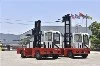
To determine whether a side loader forklift is suitable for a specific factory, one cannot rely solely on its rated load capacity. The true determinant of operational ease and efficiency is the vehicle's overall structure.
Sideloaders differ significantly in layout from standard counterbalanced forklifts. With the forks, cab, power system, and direction of travel reconfigured, the vehicle can travel parallel to the length of the load, picking up and unloading goods from the side. This structural design is not merely about driving the forklift differently; it is specifically engineered for particular types of cargo and operational spaces.
So, what does the structure of a side loader reveal about the type of factory it suits best?
The most distinctive feature of a side loader is its ability to carry loads aligned with the length of the vehicle body.
When handling long items-such as steel pipes, profiles, timber, or aluminum-standard forklifts struggle; the load's length hinders turning and necessitates wider aisles.
In contrast, a sideloader carries the load along its side, allowing the vehicle to travel parallel to the material's length. For factories requiring frequent transport of long materials along production lines, this operational method integrates more seamlessly with existing material storage and transport routes.
Therefore, if a facility handles large quantities of long, linear materials rather than standard pallets, the sideloader is a piece of equipment worth considering.
Suitability also depends on the actual aisle conditions.
In some facilities, the challenge isn't simply "narrow aisles," but the significant length of the cargo itself. For instance, when transporting materials from a warehouse to a processing area, or moving them from processing machinery to a temporary storage zone, the vehicle may need to navigate multiple turns.
In such scenarios, operational difficulty is determined not just by the vehicle's width, but by the total footprint created when the load extends beyond the vehicle body. The sideloader's structure allows long loads to be transported lengthwise, with loading and unloading performed from the side. For facilities handling loads significantly longer than standard pallets, the vehicle's overall layout is often more critical than simply minimizing the vehicle's physical dimensions.
The position of the cab also impacts actual operations.
The layout of the cab is not an arbitrary choice. Since the load is typically positioned alongside the vehicle, the driver must monitor the load's location, the position of the forks, and the surrounding aisles. When handling long materials, visibility and operating space directly impact the efficiency of picking and placing loads.
Therefore, when selecting equipment, one should look beyond just lifting height and rated capacity; factors such as cabin visibility, door and window design, seat positioning, and the layout of controls should also be taken into account.
Side-loading forklifts are particularly worth considering for the following types of factories:
First, factories that handle a large volume of long materials.
This applies to items like steel, pipes, profiles, and timber, where the load length significantly exceeds standard pallet dimensions and requires frequent transport within the facility.
Second, factories where materials must be transported along fixed routes.
If there are clearly defined transport routes connecting raw material warehouses, processing areas, and finished goods storage, a side-loading forklift can be selected to match both the vehicle's configuration and the site's layout.
Third, factories where the storage method is suited to side-loading operations.
The structural advantages of side-loading forklifts are best realized when load orientation, pick-up points, and aisle widths have been planned with this type of equipment in mind.
Fourth, processing plants that require frequent handling of long loads.
For manufacturers with daily raw material transfer needs, the equipment's suitability for long-term, repetitive operation is far more critical than its ability to perform an occasional lift.
One should not simply choose a side-loading forklift based solely on the fact that "long loads" are involved.
Factors such as load length, weight, stacking method, aisle dimensions, turning points, lifting height, and loading/unloading methods must all be considered within the context of the specific operational scenario.
While a forklift's specifications determine what it is *capable* of doing, the factory's site conditions determine whether it is *suitable* for use. By first establishing the basic operating conditions-and then selecting the appropriate load capacity, lifting height, and vehicle configuration-it becomes much easier to find equipment that truly matches the actual operational requirements.