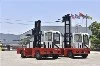
Amidst the bustling activity of modern factory floors and logistics warehouses-where goods flow with high efficiency-a quiet upgrade in the working environment is taking place.
In many indoor warehouses, food processing plants, and precision electronics facilities, electric forklifts have become reliable workhorses, prized for their key advantages: silent operation and zero emissions. What tangible changes has this quiet transformation brought to warehouse operations?
I. Bidding Farewell to Exhaust Fumes: A Clean Revolution for Indoor Operations
In the past, exhaust emissions from internal combustion forklifts operating for long periods in semi-enclosed or fully enclosed spaces posed a persistent headache for managers and frontline workers. Despite ventilation systems, the pungent exhaust from burning diesel continuously compromised indoor air quality, posing long-term risks to respiratory health.
Electric forklifts run on pure electric power, producing zero exhaust emissions throughout their operation. In industries with stringent cleanliness requirements-such as food, pharmaceuticals, cold chain logistics, and precision electronics-electric forklifts fundamentally eliminate oil and exhaust pollution. Workers no longer have to toil in warehouses thick with the smell of diesel; the indoor working environment has truly been revitalized with fresh, clean air.
II. Bidding Farewell to the "Industrial Symphony": Low Noise Protects Physical and Mental Well-being
Beyond visible exhaust fumes, invisible noise pollution is another silent hazard at the workplace. Traditional internal combustion forklifts generate high-decibel roars during startup, idling, and heavy-load operations. Prolonged exposure to such environments can easily lead to auditory fatigue, irritability, and a lack of concentration.
Thanks to the inherent advantages of electric motor drives, electric forklifts produce almost no sound other than a faint hum of electricity and the operation of hydraulic pumps, resulting in a significant overall reduction in noise.
With a quieter environment, dispatchers and teams no longer need to shout to communicate or coordinate tasks. A quiet and stable working environment significantly alleviates sensory fatigue among staff, thereby reducing operational errors and further enhancing warehouse safety.
III. Safety in the Details: Human-Centric Design Empowered by Technology
"Quiet operation and zero emissions" are merely the basics. The evolution of modern electric forklifts regarding "human-centric design and safety" is evident in every detail:
Thanks to advanced AC motor control systems (such as precise electronic control matching), power delivery remains linear and smooth during startup, acceleration, and braking. This effectively prevents cargo from tipping or falling due to sudden braking or lurching.
Mast designs are typically widened, and combined with optimized overhead guards, they maximize visibility by eliminating driver blind spots. Meanwhile, features such as adjustable seats, shock-absorbing pedals, and conveniently placed control levers allow operators of various body types to find their most comfortable working posture.
Additional safety features-including automatic speed reduction during turns, overload protection, mast cushioning systems, and automatic power cut-off when the operator leaves the seat-ensure that safety does not rely solely on the operator; instead, the vehicle itself provides a robust "line of defense."
The transition from internal combustion engines to electric power exemplifies how industrial logistics embraces human-centric principles and promotes green production. As these forklifts glide silently between racks, they leave behind not only efficiently moving goods but also a modern operational ecosystem that is healthy, quiet, and human-friendly.