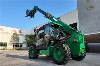
Within the boom structure of a telescopic handler-beyond the primary outer and inner boom sections-there are certain inconspicuous components known as "wear-resistant sliding pads." Positioned between the inner and outer boom sections, these pads provide support and guidance while minimizing friction during the extension and retraction of the boom.
Although these sliding pads are small in size, their fit with the boom sections directly influences the smoothness of the extension and retraction movements.
I. Where are the wear-resistant sliding pads installed?
The boom of a telescopic handler typically consists of a multi-section, nested structure, where the inner boom can extend from or retract into the outer boom. To maintain an appropriate clearance (fit) between these sections, wear-resistant sliding pads are installed at the points of contact.
These pads are generally placed on the top, bottom, or sides of the boom sections. The specific number and arrangement of these pads depend on the structural design of the boom itself. By acting as sliding contact surfaces, these pads prevent direct metal-on-metal contact, ensuring a stable, consistent fit between the inner and outer boom sections as they slide against one another.
II. What role do the wear-resistant sliding pads play during boom extension and retraction?
During operation, the boom must frequently extend and retract. When carrying a load, the inner and outer boom sections are subjected to both the weight of the cargo and various forces resulting from the boom's specific configuration. In this context, the wear-resistant sliding pads serve three primary functions:
Supporting the boom: They provide support between the inner and outer boom sections, stabilizing their relative positions and preventing direct metal-to-metal contact that could lead to crushing or deformation.
Guiding the movement: They act as guides for the relative sliding of the boom sections, constraining the inner boom's path of motion to ensure it moves in the intended direction without veering off course.
Reducing friction: By serving as wear-resistant sliding contact surfaces, they prevent direct friction between metal surfaces during extension and retraction, thereby reducing sliding resistance.
In short, while the wear-resistant sliding pads do not provide the power for extension or retraction, they are essential structural components that ensure the boom operates smoothly and correctly.
III. What are the consequences of wear on wear-resistant sliding blocks?
During long-term extension and retraction operations, wear-resistant sliding blocks are subjected to continuous friction and loads. Over time, their surfaces gradually wear down, resulting in a reduction in thickness. If this wear exceeds specified limits, the clearance between the inner and outer boom sections increases. This can lead to instability-such as swaying or shaking-during boom extension and retraction, and it may also accelerate damage to other contact surfaces within the boom structure.
Consequently, wear-resistant sliding blocks are considered "wear parts" (components prone to regular wear) within the telescopic boom assembly. If any issues are detected, they must be replaced in accordance with equipment maintenance requirements to prevent mechanical failure or other safety incidents.
Although small in size, wear-resistant sliding blocks play a critical role in providing support, ensuring proper guidance, and minimizing friction. Their effective performance is essential for maintaining a precise fit between the inner and outer boom sections, thereby enabling smooth extension and retraction movements.