In industries such as mining and stone processing, material handling has always been a crucial part of the production process.
Many people believe that the core equipment in mining operations is mainly excavators, loaders, and other equipment used for mining and loading. However, in reality, the large-scale transfer of materials from the mining area to the storage area, and then to the subsequent transportation stages, also affects the overall operational efficiency.
Unlike ordinary industrial scenarios, the mining environment is characterized by complex road conditions, heavy materials, and the need for long-term continuous operation. Therefore, material handling equipment not only needs to have a large load-bearing capacity but also comprehensive performance to adapt to harsh environments.
This is why more and more mines and the stone industry are beginning to focus on specialized material handling equipment.
I. What are the special challenges faced by material handling in mining?
The mining environment is usually not as flat and fixed as that of a factory or warehouse. In actual operation, equipment may need to face:
1. Complex road environment
Mining roads are usually composed of gravel, dirt roads, or unpaved surfaces, with potholes, slopes, and uneven surfaces. For material handling equipment, in addition to moving goods, it is also crucial to ensure stability on complex terrain. High ground clearance, good maneuverability, and stable drive performance are all essential requirements for mining equipment.
2. Heavy Material Handling Needs
The objects handled in the mining and stone industries are typically heavy and large in size.
For example:
- Stone blocks;
- Large ores;
- Heavy steel or engineering materials.
These materials not only demand high rated load capacity from the equipment but also test the overall structural strength, hydraulic system, and long-term reliability.
3. Long-Term, High-Intensity Continuous Operation
Mining production often requires maintaining a high degree of operational continuity.
Besides being able to complete a single handling task, the equipment also needs to withstand the following during long-term operation: power output; heat dissipation requirements; component durability; and operational stability.
Therefore, the design focus of mining equipment is not only on "whether it can complete the task," but more importantly, "whether it can continuously and stably complete the task."

II. Why are wheeled forklifts suitable for mining applications?
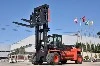
For the complex working conditions of mines, wheeled forklifts are designed with a greater emphasis on adaptability to outdoor environments.
1. Better Ability to Navigate Complex Roads
Compared to equipment used in fixed locations, wheeled forklifts typically employ engineered off-road chassis designs and are equipped with tires suitable for complex terrain. On unpaved roads such as gravel and dirt tracks, the equipment maintains good driving stability, improving on-site transfer efficiency.
In the constantly changing environment of mines, mobility is a crucial factor affecting equipment efficiency.
2. Better Heavy-Duty Capacity
Mine material handling often involves heavy materials, therefore the equipment needs robust structural load-bearing capacity.
Wheeled forklifts meet the needs of heavy material handling through optional reinforced frames, heavy-duty power systems, and stable hydraulic systems.
In practical applications, appropriate attachments can be matched according to the characteristics of different materials, enabling more flexible handling operations.
III. Selecting Mining Equipment Should Not Be Based Solely on Parameters, But Also on Working Conditions
For construction machinery, parameters are only one part of the equipment's capabilities.
In mining environments, the factors that truly determine the suitability of equipment include:
- The complexity of the operating environment;
- The type and dimensions of the materials being handled;
- Daily working hours;
- Road conditions;
- Requirements for efficiency and stability.
The same equipment parameters can produce completely different results under different working conditions.
Therefore, the core of selecting mining equipment is not pursuing larger tonnage or higher specifications, but finding a solution that matches the actual operational needs.
Mining operating environments are complex and ever-changing. For material handling equipment, the real challenge is not just completing a single material movement, but maintaining stable operation during long-term, high-intensity work.
Therefore, equipment suitable for mining scenarios not only needs strong load-bearing capacity, but also requires targeted design in terms of chassis structure, power system, hydraulic performance, and overall reliability.
As an engineering machinery R&D and manufacturing enterprise, Weisheng Machine always focuses on the actual needs of different application scenarios. In the R&D of equipment such as wheeled forklifts, we continuously optimize product structure and configuration based on the operational characteristics of industries such as mining and stone processing, enabling the equipment to better adapt to complex working environments.