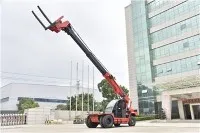
With the increasing application of telescopic boom forklifts in construction, agriculture, and logistics, more and more companies are purchasing this multi-functional equipment.
Equipment delivery involves not only manufacturing but also the transportation process, which significantly impacts the customer's final user experience. A telescopic boom forklift undergoes multiple stages, including loading, securing, protection, and sea freight. Any oversight in handling details can affect the equipment's condition upon arrival.

1. Choosing the Appropriate Transportation Method Based on Equipment Dimensions
For standard models, container shipping is typically used. A well-designed system allows for direct loading into containers. This method is mature and offers good protection.
For different models or configurations, manufacturers need to consider:
- Overall machine dimensions
- Boom length
- Tire specifications
- Destination port conditions
Choose the appropriate transportation solution, including standard containers, open-top containers, and flat rack containers. Advance planning of the transportation plan helps customers reduce transportation costs while ensuring equipment safety.
2. Container Loading Requires Professional Operation
Although the equipment has strong maneuverability, attention to operational details is still necessary during container loading:
Control the vehicle's speed when entering the container;
Avoid collisions with components such as the cab and boom;
Confirm the equipment's parking position to ensure reasonable weight distribution;
Secure the tires and equipment firmly to prevent shaking during sea transport.
Managing every operational detail ensures both loading and unloading efficiency and reduces potential risks during transportation.
3. Pre-Export Equipment Protection
Sea transport is long, humid, and salty, so comprehensive protection is essential before departure. First, verify the operating conditions of the two core systems, hydraulic and electrical, and then apply a rust-proof layer to exposed parts to prevent moisture corrosion. These details, along with proper securing, ensure the equipment arrives in good condition at port.
4. Factory Inspection Ensures Delivery Quality
Before the equipment is officially shipped, a full-scale factory inspection is usually completed: Thoroughly check the engine's operating condition, test the hydraulic system's response performance item by item, and verify the operational stability of the boom's extension and lifting. The braking system's safety performance is rigorously verified, and the overall machine appearance and all accessories are inventoried and checked.
Multiple rounds of meticulous inspections and layer-by-layer checks ensure the equipment is in stable and good working condition before it can be confidently delivered to the customer.
Exporting telescopic boom forklifts is not simply a matter of loading and shipping. Through standardized export procedures and a professional service system, manufacturers can help customers reduce procurement risks and get the equipment into operation more quickly.