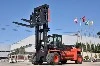
The overhead guard is a critical safety component of a forklift. During material handling, if items on a pallet shift or slide, the operator could be struck by falling objects. The overhead guard provides a measure of overhead protection; however, its actual protective capacity depends heavily on its structural design, and it cannot effectively stop every type of falling object.
How does an overhead guard provide protection?
Typically constructed from metal, an overhead guard consists of a roof section and supporting structures. Together with the forklift's mounting framework, it creates a protective space above the operator, designed to shield against falling objects from specific directions and within defined parameters.
The size, shape, and stacking method of the cargo affect its stability during transport. For instance, unevenly stacked boxes or unsecured long items increase the risk of the load shifting or falling. While an overhead guard offers some protection, it is not a substitute for the stable loading of cargo.
Does an overhead guard protect against all falling objects?
No. The protective capability of an overhead guard is determined by its structural strength, support configuration, and design specifications. Because objects of different weights and shapes generate varying levels of impact, an overhead guard cannot stop every falling object.
In environments such as mines or construction sites, heavy items-like large rocks-falling from a significant height may generate an impact that exceeds the guard's design limits. Consequently, an overhead guard should not be viewed as a universal shield capable of withstanding the impact of any falling object; its protective function has clear, defined boundaries.
Why shouldn't an overhead guard be modified?
An overhead guard is more than just a metal frame installed above the operator. Its roof, supports, and connection points are engineered to work in unison to withstand forces within a specific design range. Unauthorized cutting, welding, or the removal of components can alter the distribution of forces and compromise the structural integrity of the entire unit. Even seemingly minor modifications can have significant, unpredictable effects on the guard's protective performance. Furthermore, an overhead guard and an enclosed cab serve different functions. While a cab provides the operator with a relatively self-contained workspace, the extent to which its windows, doors, roof structure, and other components offer protection depends on their specific design. The presence of a cab on a forklift does not automatically mean it can withstand the impact of falling rocks or other heavy objects.
The protective capability of an overhead guard is determined by its structural design; having a clear understanding of the scope of this protection is a crucial aspect of grasping forklift safety.