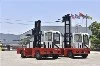
Walking into a sand and gravel aggregate production plant, the roar of equipment fills the air. Material transfer is a crucial link throughout the entire plant: from feeding raw materials from the stockpile to the production line, to loading finished products onto trucks for transport, every step relies on material handling. The speed of transfer directly impacts the plant's production costs and capacity limits. Loaders, with their flexibility, efficiency, and ability to withstand various environments, have become indispensable material handling assistants for everyone in the sand and gravel plant.

- Meeting High-Frequency Material Transfer Needs
Sand and gravel aggregate production lines mostly operate around the clock. Stockpiles of raw stones and crushed stone need to be moved back and forth between various work areas, making the transfer tasks heavy and urgent. The loader's large-capacity bucket and ample traction allow it to dig, transfer short distances, and unload smoothly, significantly reducing handling time. Compared to manual handling or small-scale machinery operations, it has a larger single-load capacity and faster round-trip speed, completing several times the amount of transfer work in the same amount of time, steadily supporting the entire production line without interruption, and eliminating frequent shutdowns due to material shortages.
- Improving Production Line Feeding Efficiency
Aggregate processing is most vulnerable to insufficient raw material supply. Once the supply is cut off, crushers and screening machines can only run idle and stop. With loaders on site, stones can be continuously and evenly transported into crushing equipment, screening bins, and storage bins, fundamentally avoiding the problem of downtime due to material shortages. Factories can choose loaders with appropriate tonnage and bucket specifications according to their own operating conditions, ensuring that the feeding rhythm perfectly matches the processing equipment.
- Adapting to Complex and Harsh Working Conditions
The working environment in sand and gravel mines and aggregate plants is far from friendly: roads are full of potholes and gravel, muddy in rainy weather, and there are many steep slopes within the site. Dust is also prevalent year-round, testing the durability of mechanical equipment. Good equipment will have a robust design, with thickened and reinforced frames, large-size deep-tread tires, and powerful engines. Whether on bumpy gravel roads, muddy surfaces, or steep slopes, it can navigate smoothly. It maintains stable operation even in harsh environments, minimizing work interruptions due to road conditions.
For aggregate processing companies, production efficiency depends not only on crushing and screening equipment but also on an efficient material handling system. While loaders are not the main players on the production line, they play a crucial role in connecting various production stages. Only when materials move quickly, supply is timely, and loading is efficient can the entire production line truly reach its full capacity.