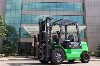
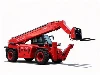
Over the past decade, telescopic handler forklifts (telehandlers) have seen significant increasing usage across construction sites, logistics yards, and agricultural settings globally worldwide. Thanks to their highly efficient extendable booms, stable chassis, and wide-ranging compatibility with multiple attachments, they can effectively replace certain forklifts and specialized lifting equipment, enabling more flexible on-site operations in diverse scenarios.
- Flexible Operation Beyond Reach
The first major change lies in the way work is performed. Traditional forklifts can only transport materials and must operate close to the load. Telehandlers are different: their extendable booms can reach over trenches or obstacles to access the load, performing lifting or forward movements to accurately position and pick up or place materials. This ability to operate without being in close proximity is a key reason telehandlers are gradually replacing conventional equipment.
- Multi-Purpose Efficiency
Moreover, a single telehandler can serve multiple scenarios, making it a cost-effective choice for many businesses-especially small and medium-sized enterprises. Owning one telehandler is roughly equivalent to having a forklift, a loader, and a crane combined. This versatility stems from the telehandler's compatibility with various attachments, reducing procurement costs, enabling multi-purpose use, minimizing equipment investment, and simplifying operational management.
- Meeting Modern Demands
With urbanization, denser building clusters, the rise of prefabricated construction, more mountainous roads, open-air storage yards, and the increasing adoption of telehandlers in modern agriculture for stacking, loading, and unloading, the market demands compact, agile, off-road-capable machines. As a result, telehandlers are becoming increasingly essential.
The shift from simple handling to precise positioning represents an upgrade in engineering operations from "extensive" to "intensive," which is why telescopic handlers are increasingly being used in the global engineering industry. Telescopic handlers overcome the limitations of traditional equipment while improving operational efficiency, meeting the core needs of businesses and modern engineering projects: reducing costs, improving quality, and increasing profitability.