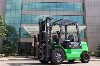
Selecting a warehouse forklift involves more than just looking at its rated capacity and lifting height. Factors such as cargo dimensions, racking layout, floor conditions, and the width of warehouse aisles all significantly impact how the forklift performs in practice.
For instance, with a 2-ton forklift, the actual weight it can safely handle varies depending on the dimensions of the cargo and the height of the racking. Furthermore, choosing the wrong type of tires can lead to floor damage or instability during operation. When configuring a warehouse forklift, pay close attention to the following four aspects:
1. Rated Load Capacity
The rated load capacity specified for a piece of equipment does not necessarily apply to all operating conditions. When selecting a model, it is essential to understand the "load center distance."
The load center distance is the horizontal measurement from the center of gravity of the load to the vertical front face of the forks. For standard counterbalanced forklifts, the rated load center distance is typically 500 mm, though this standard can vary by model.
If a load is long-causing its center of gravity to extend beyond the standard load center distance-the equipment's effective load capacity will decrease. Similarly, when a load is lifted to a significant height, the remaining load capacity must be recalculated.
Additionally, the installation of attachments-such as sideshifters or clamps-will also reduce the forklift's load-carrying capacity.
When selecting a unit, confirm with the manufacturer the "residual" (remaining) load capacity for the specific model, accounting for the intended lifting height, load center distance, and any attachments used. This data is particularly critical for warehouses that utilize high-bay racking.
2. Mast Configuration: Consider Both Lifting Height and Retracted Height
The number of stages in a mast determines the equipment's structure, maximum lifting height, and its overall height when fully retracted. Common configurations include two-stage, three-stage, and four-stage masts, each suited to different lifting requirements and warehouse ceiling heights.
A two-stage mast consists of an inner and outer section; its simple design makes it well-suited for general warehouse operations, such as stacking and loading/unloading at low-to-medium rack levels. A three-stage mast features three telescoping sections, allowing for greater lifting heights-ideal for accessing goods on high-level racking in multi-tier warehouses.
A four-stage mast includes additional telescoping sections, offering even greater lifting capacity; these are typically used in warehousing or loading/unloading operations that require exceptionally high lifting capabilities.
Furthermore, two-stage, three-stage, and four-stage masts are all available in "full free-lift" versions. With full free-lift, the forks can be raised independently without extending the overall height of the mast assembly. This is particularly useful for operations inside shipping containers or in areas with limited overhead clearance.
3. Tire Types: Matching Tires to Warehouse Flooring
Warehouse flooring varies-ranging from concrete and epoxy-coated surfaces to asphalt and transitions between indoor and outdoor areas. Different tire types offer distinct advantages in terms of shock absorption, wear resistance, puncture resistance, and floor protection.
- Solid Tires
These do not require inflation, eliminating the risk of downtime caused by punctures from sharp debris. They are well-suited for indoor environments with relatively smooth floors and high-frequency handling operations.
- Pneumatic (Air-Filled) Tires
Filled with compressed air, these tires provide a degree of cushioning. They are ideal for outdoor asphalt surfaces, storage yards, and uneven ground.
- Non-Marking Tires
Made from specialized materials or compounds, these tires prevent the black scuff marks often left on floors. They are essential for environments that demand high standards of cleanliness, such as food packaging facilities, electronics manufacturing plants, and pharmaceutical warehouses.
4. Aisle Width
The width of the aisles between warehouse racks directly impacts maneuvering and the ability to load or retrieve goods.
Standard four-wheel counterbalanced forklifts are suited for warehouses with wider aisles, where they can handle tasks like loading/unloading pallets, stacking, and short-distance transport. Three-wheel counterbalanced forklifts feature a more compact steering design, offering greater agility in warehouses with limited space.
For high-level racking in narrow-aisle environments, reach trucks are a common solution; their masts can extend forward, allowing them to access goods within tight racking aisles.
Note: A forklift's minimum turning radius is not the same as the actual aisle width required for operation. When calculating aisle dimensions, it is necessary to consider pallet length, the external dimensions of the cargo, and the right-angle stacking width, while also allowing for an operational margin.
If you are in the process of selecting a warehouse forklift, please provide our technical team with details regarding cargo weight, maximum rack height, pallet dimensions, and aisle width. We will then recommend the most suitable model and configuration to meet your specific requirements.