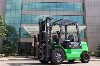
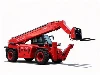
A telehandler uses an extendable boom to lift and move materials at different heights and distances. During lifting operations, the boom extension, lifting height, and load weight all affect the forces acting on the machine. Many telehandlers are equipped with hydraulic outriggers at the front of the frame to provide additional support and help prevent the machine from becoming unstable.
Outriggers are important working components of a telehandler. Depending on the machine's structural design, their installation positions, extension methods, and support arrangements can vary.
The most common types include the following:
1. Front-Mounted Outriggers
Front-mounted outriggers are installed at the front of the frame, with one hydraulic outrigger on each side. During operation, the hydraulic system extends the outriggers downward until the support pads make contact with the ground, providing additional support.
The outriggers must be retracted during travel to avoid interference. This design also requires sufficient installation and operating space around the frame, front axle, and boom to ensure that the outriggers can move freely.
2. Swing-Out Outriggers
Swing-out outriggers extend outward from both sides of the machine through a swinging mechanism. Once they reach the required position, they extend downward to support the machine.
These outriggers usually consist of a swing mechanism, hydraulic cylinders, and support pads.
During operation, the outriggers swing outward, moving the support points farther away from the machine. Before travel, they are folded back close to the frame to avoid interfering with normal driving.
The design must take into account the swing range and ensure sufficient clearance from nearby obstacles when the outriggers are fully extended.
3. Telescopic Beam Outriggers
This type of outrigger uses a horizontally extending beam to move outward on both sides of the machine. Vertical hydraulic cylinders then extend downward until the support pads reach the ground.
The main components include telescopic beams, hydraulic cylinders, and support pads. The extension stroke of the beams determines how far the support points can extend outward. The actual range depends on the machine's design requirements.
The Main Role of Outriggers During Operation
When a telehandler extends its boom forward to lift a load, the farther the load is from the machine, the greater the overturning moment becomes. Load weight, lifting height, and boom extension all directly affect the machine's load capacity.
When the outriggers are deployed, they provide additional support points at the front or sides of the machine. This increases the support base and improves stability during lifting operations.
Using the outriggers correctly is particularly important when the boom is extended over a long distance or when lifting loads to greater heights.
Ground conditions also affect how well the outriggers perform. Soft or uneven ground, or support pads that are not fully in contact with the ground, can reduce support reliability. Operators must follow the instructions in the machine's manual during operation.
What Factors Should Be Considered in Outrigger Design?
Outriggers are not simply separate components attached to the frame. Their design must match the overall machine layout and operating requirements.
Support Range: The position of the outriggers when fully extended determines the size of the support base. It must be designed according to the machine's load requirements and stability needs.
Installation Position: The outriggers must be securely connected to the frame while avoiding interference with the movement of other components.
Hydraulic Control: Outrigger movement is driven by the hydraulic system. Cylinder stroke and operating sequences must match the machine's overall design.
Ground Adaptability: The support pads must make stable contact with the ground, and the ground must have sufficient load-bearing capacity for the operation.
The right outrigger configuration is an important factor in ensuring that a telehandler can perform lifting operations safely and stably under its specified working conditions.