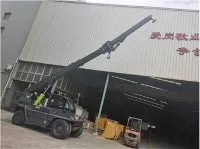
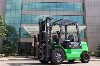
Maintaining cargo stability is a significant challenge when working in uneven outdoor terrain. Unlike the smooth floors of a warehouse, outdoor and wilderness terrain can be surprisingly full of potholes. The off-road forklift's ability to be a "wilderness transporter" relies not only on its powerful engine but also on its perfectly integrated stability system.

1. Mast Tilt Angle
Faced with undulating terrain, the mast tilt angle system of an off-road forklift is the core design element for cargo stability, allowing for a 6-degree forward tilt and a 12-degree backward tilt. While these values may not seem large, they effectively adjust the cargo's center of gravity in complex terrain, much like how a person instinctively adjusts their posture when hiking.
The 12° backward tilt angle plays a crucial role when climbing inclines, bringing the cargo's center of gravity closer to the forklift's center, preventing it from sliding forward and falling.
For unloading, a 6° forward tilt angle is used. The forks are flush against the bottom of the cargo for precise unloading, and the fork remains relatively stable even on slight undulations, preventing swaying.
2. Automatic Leveling and Hydraulic Shock Absorption
When encountering terrain with significant elevation differences, the mast tilt angle may be insufficient. High-end off-road forklifts typically feature a lateral compensation system. No matter how much the chassis tilts due to uneven ground, sensors detect angle changes and quickly adjust the vehicle to maintain level.
Vibrations from the ground during operation can easily damage goods and cause operator fatigue. Good off-road forklifts are designed with shock absorption systems to prevent hard impacts from being directly transmitted to goods and personnel, reducing damage rates and operator fatigue during transport.
3. Off-Road Grade Tires
The "big feet" tire design of off-road forklifts is not only for off-road capability but also fundamental for operating on uneven terrain.
They generally use low-pressure, wide-base tires, which provide a wider contact area with the ground and lower pressure than the narrow tires of ordinary forklifts, making them less prone to getting stuck and eliminating the hassle of maneuvering. Furthermore, the deep tread pattern provides strong grip and reduces the risk of slippage. Combined with a wide wheelbase, even when lifting goods, it helps prevent tipping over, making work safer.
Thanks to these design features, off-road forklifts can maintain both efficiency and stability no matter how harsh the environment. Understanding these designs makes operation easier.