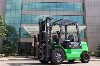
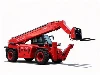
In industries such as stone quarries, logistics, and construction, the lifting of large stone slabs, building materials, and heavy equipment panels, as well as container loading, are frequent operations. Equipment selection affects operational safety, efficiency, and cargo integrity. Compared to forklifts, telescopic boom cranes demonstrate a more suitable core advantage in these scenarios.


1. More Scientific Force Distribution Principle, Avoiding Damage to Large Slabs
Large slabs are generally large in size, have concentrated weight, and low material toughness. Uneven force distribution easily leads to cracking, deformation, or surface scratches.
Forklifts rely on the forks to "lift from the bottom," achieving only two points of support with the two forks, making the center of gravity prone to shifting. Furthermore, the sharp edges of the forks have minimal contact surface with the large slab, making them prone to scratches and difficult to secure.
Telescopic boom cranes utilize specialized lifting ropes, threaded through the bottom of the large panel and looped back to the telescopic boom's double-arm for secure lifting. This ensures more even and stable force distribution. Furthermore, it allows for the replacement of panel clamps and other attachments, preventing damage from localized compression and guaranteeing the integrity of the panel.
2. More Flexible Operation, Adapting to Container Loading Space Constraints
The main challenges in container loading operations are limited internal space and restricted operating angles. Large panels must be placed vertically inside the container, demanding extremely high operational flexibility from the equipment.
Forklift operation relies on vehicle movement, requiring it to drive into the container or operate close to the container opening. Typically, two forklifts are needed to deliver the panel, increasing the risk of collision with the container walls and limiting angle adjustments in confined spaces due to forklift length. Moreover, forklifts cannot precisely adjust their position if tilting is required.
Telescopic boom cranes, with their multi-section telescopic booms, can smoothly deliver large panels into the container from the outside by extending and retracting the boom, even enabling integrated operations such as "direct entry from the ground," avoiding secondary handling.
3. More Comprehensive Safety Protection, Mitigating Operational Risks
The risks of large panel lifting and container loading operations are concentrated on cargo falling, equipment tipping over, and personnel injury. Telescopic boom cranes are better suited to the safety needs of these scenarios.
Forklift safety protection mainly focuses on the vehicle itself, lacking specific design for large panel lifting. If the center of gravity of the large panel shifts during lifting, the forklift lacks automatic warning functions, easily leading to cargo slippage; moreover, operators need to observe the operation at close range, and if cargo tipping occurs, the personnel safety risk is extremely high.
Telescopic boom cranes are equipped with torque limiters, intelligent detection, and other safety systems: automatically cutting off the lifting action in case of overload to prevent the large panel from swaying and falling due to operational errors; some models also have remote control capabilities, allowing operators to direct operations from a safe area, away from the risk zone.
Large panel lifting and container loading operations primarily prioritize the safety of goods and personnel, as well as high efficiency and adaptability to various scenarios. The unique features of telescopic boom cranes precisely meet these needs. In contrast, forklifts are better suited for short-distance, low-tonnage goods handling on flat surfaces, rather than specialized lifting scenarios.
Choosing the right equipment can reduce cargo damage, improve operational efficiency, mitigate safety risks at the source, and facilitate efficient production operations.