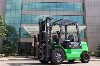
When talking about counterbalance forklifts, one might think of them as large machines used for moving goods in logistics yards. However, a look at their development history reveals a transformation from "brute force" to "intelligent efficiency." The evolution of forklifts is a continuous push towards safety, efficiency, and technological boundaries.

1. Early Solutions to Handling Problems Through "Stacking Counterweights"
In the early 20th century, docks and factories were filled with heavy wooden crates. Manual handling was costly and inefficient. To address this, the prototype of the forklift gradually emerged. However, the early counterweight design was very rudimentary, simply stacking heavy iron or lead blocks at the rear of the vehicle to offset the weight of the goods in front.
In complex working conditions, this greatly increased the safety risk, leading to tipping over. Safety was entirely dependent on "experience and risk."
2. The Industrial Revolution: Power and Structural Standards
With the advancement of the Second Industrial Revolution, internal combustion engines began to replace primitive manual labor or simple machinery, giving forklifts greater power. During this period, forklift chassis structures gradually became standardized, and the "stability triangle" became a core design principle, ensuring basic operation even under harsh working conditions in different seasons.
Forklift masts began to use high-strength alloy steel, improving lifting height and heavy-duty capacity, doubling durability and practicality.
3. Modern Leap
Entering the 21st century, increasingly stringent environmental emission standards led to a new "energy revolution" driven by lithium battery technology, achieving a perfect balance between zero emissions and low noise.
Moreover, modern design not only focuses on machine performance but also on operator comfort. Fully suspended seats prevent fatigue during long working hours, and the control system is easy to operate, making the machine user-friendly and the operator comfortable.
Looking back, counterbalance forklifts have evolved from simple tools for moving wooden crates to intelligent equipment; each upgrade has been driven by industrial needs. Choosing equipment with advanced evolutionary genes not only improves current operational efficiency but also represents a long-term investment for the future.