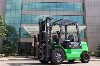
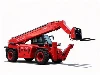
On construction sites or in mines, loaders appear large and cumbersome, but in actual operation, they are quite agile. The secret lies in their unique articulated steering design. This structure, which "folds" and then "assembles" the vehicle body, not only demonstrates power but also represents an ultimate balance between space utilization and stability in engineering design.
1. From a Single Body to "Folding" Evolution
Most vehicles rely on front-wheel steering, but loaders are different; they use "waist steering." Simply put, their body is divided into front and rear sections, connected by a set of vertical pin joints, or hinge points. Like a person's waist, these sections can rotate flexibly.
The front and rear sections of the vehicle body can deflect independently. The loader's articulated structure allows it to more naturally "avoid" obstacles, without requiring cumbersome adjustments to the overall body structure. Moreover, because the loader's body can fold at the midpoint, its turning radius is exceptionally small, allowing it to turn on the spot even in extremely narrow alleys. This space utilization is unmatched by traditional steering systems.
2. Precise Control of Power Balance
Some might wonder if articulated steering is particularly strenuous for such a large machine. Actually, it doesn't rely on physical strength, but rather on a highly precise hydraulic system, like giving the loader flexible "nerves" and powerful "muscles."
On each side of the articulation point, there is a hydraulic cylinder. Like human muscles, they alternately extend and retract, propelling the body to fold and turn. When the operator turns the steering wheel, the hydraulic valves, like the nervous system, precisely distribute the flow of hydraulic oil, ensuring stable and accurate steering without any jerking or loss of control. The articulation point positions are precisely calculated, ensuring that the loader's center of gravity remains within a safe range even during turns. This "stability while in motion" design effectively prevents the loader from tipping over under heavy loads, making it exceptionally safe.
3. Environmental Adaptability
Besides flexibility and stability, the articulated structure gives loaders superior terrain adaptability. During operation, the loader's rear wheels always follow the path swept by the front wheels. This significantly reduces tire wear on complex road surfaces and provides better maneuverability in muddy and rugged terrain, preventing them from getting stuck or slipping. Moreover, whether it's high-temperature loading in summer or snow removal in winter, the articulated system provides stable operational feedback. Even during prolonged high-intensity work, operators can maintain precise control and efficiency won't be affected by equipment malfunctions.
Understanding the operating principles of this "mechanical joint" not only helps us operate loaders more scientifically and safely but also allows us to experience the power of industrial equipment and appreciate the infinite possibilities brought by technological innovation.