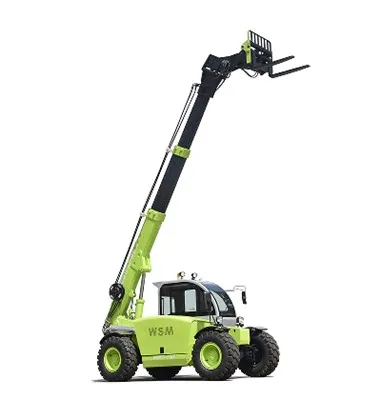
In warehousing, logistics, and industrial handling, side forklifts, with their unique advantages of side loading and unloading and narrow aisle navigation, have become essential equipment for specialized handling needs, such as long, narrow cargo. Whether in cramped warehouse racking areas or densely packed port yards, mastering the "scenario-matching" selection process is key to ensuring safe and economical operations.
For narrow aisles, choose a compact and precise side forklift.
Narrow aisles require small size and high maneuverability. Prioritize a narrow width to ensure nimble maneuverability between shelves.
Forklifts should ideally support lateral fine-tuning to prevent collisions between cargo and shelves due to narrow aisles. It is also recommended to equip them with a side-viewing assist system and warning system for real-time monitoring of lateral conditions to reduce risks caused by blind spots.
For ports and open-air yards, choose a heavy-duty, durable side forklift.
Ports and open-air yards present complex operating environments, characterized by high temperatures, intense sunlight, dust, and uneven surfaces. When choosing a side loader, it's best to choose one with a rated load of 5 tons or more. The frame should be thickened and reinforced to improve impact resistance. The hydraulic system should also be well-protected to prevent intrusion from dust, rain, and seawater.
The tires should also be wear-resistant and non-skid. For high-frequency operations, consider equipment equipped with a shock-absorbing system to reduce damage from ground vibrations and extend its lifespan.
Cold chain warehousing,Opt for side loaders with low-temperature adaptability
Cold chain warehousing imposes stringent requirements on equipment's low-temperature tolerance. Conventional side loaders may experience power failure and operational lag, necessitating attention to system compatibility and personnel safeguards during selection.
Hydraulic oil must be replaced with a low-temperature resistant type to prevent freezing at low temperatures. For cold chain warehousing, zero emissions and zero pollution are essential, so it is best to opt for an electric side loader.
The cab should also be equipped with a heating and air conditioning system. The forklift forks are recommended to have anti-frosting treatment to prevent cargo from sticking to the forks due to frost, thereby reducing loading and unloading delays. The equipment must be waterproof, rustproof, and anti-slip. Additionally, protective roof racks and front guardrails with impact-resistant design are essential.
The selection of a side forklift is not based on the principle of "the higher the parameters, the better". Instead, it needs to be selected according to the adaptability of the scene. The equipment should be selected in a targeted manner based on the needs and characteristics of the operation scene. This can maximize the core advantages of the equipment, reduce the frequency of subsequent maintenance and energy consumption costs, and truly realize the long-term operational value of "precise investment and efficient output".