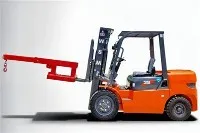
The same off road forklifts,and the same handing task. Why do some equipment's tires show significant wear after about a year, while others remain in good working order?
Many people's first thought might be differences in tire quality. However, tire lifespan is rarely determined by a single factor. Besides the tire's inherent quality, the operating environment, driving habits, and routine maintenance all directly impact the wear rate. Understanding these factors helps extend tire life and reduce equipment downtime and replacement costs.
Complex Terrain Is Often The Real "test"
Off-road forklifts typically operate on unpaved surfaces, but different working conditions affect tires differently.
For example, when operating in environments like gravel pits or quarries, sharp stones constantly rub against the tire tread, potentially scratching the rubber or causing nicks. On softer surfaces like mud or farms, while tires can gain traction more easily, frequent slippage will also accelerate tread wear.
Therefore, even if two pieces of equipment operate for similar durations, their tire wear rates can differ significantly depending on the operating environment.
Driving Habits Are Crucial
Many tires don't fail prematurely due to natural wear, but rather because uneven wear gradually develops during daily operation.
Frequent sharp turns under full load increase friction on the tire sidewalls. Rapidly traversing potholes or directly running over large stones subjectes the tires to repeated impacts. These actions may not cause immediate tire damage, but over time, they shorten the overall lifespan of the tires.
Both Overinflation And Underinflation Are Detrimental
Maintaining proper tire pressure is essential for off-road forklifts using pneumatic tires.
Insufficient tire pressure increases the contact area between the tire and the ground. The tire shoulder area wears more easily, and tire deformation is also accelerated. Overinflation puts more pressure on the center of the tire tread, leading to faster wear in the center on hard surfaces. Therefore, regular tire pressure checks are necessary to prevent equipment malfunctions and, more importantly, to protect personnel and equipment safety, avoiding the injuries caused by tire blowouts.
Prolonged Overloading Accelerates Tire Fatigue
Every off-road forklift has a rated load, a crucial design principle.
If you continuously transport goods exceeding the rated load, the tires will bear greater pressure. This not only accelerates wear but also increases the risk of tire fatigue and damage. Overloading increases the workload on the transmission, braking, and hydraulic systems, making it an unsustainable and unsafe operating practice.
There's No Fixed Answer To Tire Lifespan
Some people ask, how long can a set of off-road forklift tires last?
In fact, there's no uniform time standard. Tire lifespan is affected by various factors such as equipment usage frequency, ground conditions, driving style, load, and maintenance, making it difficult to measure simply in one, two, or longer periods.
For equipment managers, it's more important to focus on maintaining good usage and maintenance habits than on how long the tires will last. Proper operation, regular inspections, and scheduling equipment use according to actual working conditions are usually more effective in extending tire lifespan than simply replacing them with more expensive tires.