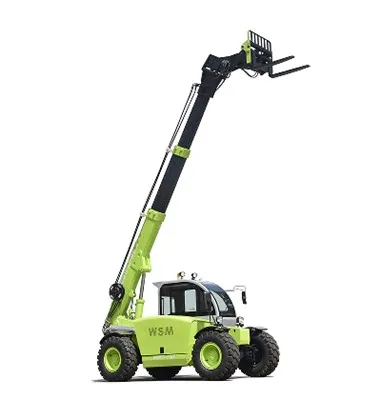
When purchasing a large loader, the first question encountered during transportation might not be "how heavy it is," but rather-can this machine be transported at its current size?
Large loaders are quite large, and transportation requires consideration of vehicle width, loading height, road height restrictions, and port and ship loading conditions. If the transport of the entire machine is subject to size limitations, it is necessary to disassemble some components according to the actual transportation plan.

Sometimes it's not that it's too heavy, but that it's too large
Many people's first reaction is: "The equipment is so heavy, wouldn't it be easier to transport after disassembling it?"
Actually, it's not entirely that simple.
For transporting large construction machinery, weight is only one factor. Length, width, and height are equally important.
Especially height. After the loader is loaded onto the transport vehicle, the height of the equipment itself must be added to the height of the vehicle's loading platform. If the total height exceeds the height limit of the transportation route, even if the weight of the equipment does not exceed the vehicle's load capacity, it may not be able to pass normally.
The same applies to width. Equipment that is too wide may involve special transportation, affecting the transportation route, vehicle arrangement, and costs.
Therefore, some loaders don't necessarily need to be disassembled; rather, disassembly makes them easier to fit for transport conditions.
Whether to disassemble or not depends on the transport method
There isn't a fixed "transport disassembly plan" for loaders.
For short-distance road transport, where the route is wide and there are no obvious height restrictions, transporting the whole machine is more convenient.
For international exports, loading, port transshipment, and sea freight conditions must also be considered. Large equipment sometimes uses flat rack containers, open-top containers, or, depending on the ship's conditions, bulk cargo transport.
Different transport methods have different requirements for equipment dimensions
Therefore, before determining a disassembly plan, it's usually necessary to determine the equipment dimensions, destination port, transport method, and loading/unloading conditions.
Which parts to remove is also not arbitrary. The purpose of transport disassembly is to reduce transport dimensions or make the equipment easier to load and secure.
Which specific parts to remove depends on the equipment's structure.
Some equipment may require removing the bucket, boom, and other working devices, while others only need to have some extended parts removed. For large equipment, the weight of the disassembled parts and lifting conditions must also be considered.
Here's a crucial question: How do you transport this component after it's been disassembled?
Simply disassembling the entire machine without considering the size, weight, and securing methods of the removed parts doesn't truly solve the transportation problem.
Securing is more important than simply "disassembling"
During transportation, the equipment isn't stationary.
Vehicles start, brake, and turn; ships experience swaying and vibration during sea transport. Disassembled components like buckets and working devices need to be secured according to their weight and center of gravity.
Easily damaged areas also require protection; hydraulic lines, connectors, and electrical wiring must not be squeezed or impacted during transport.
Upon arrival at the destination, a thorough inspection is necessary
After the equipment arrives at its destination, the disassembled parts need to be reinstalled.
After installation, the connections, fasteners, hydraulic lines, and related functions must be checked. This step is essential for equipment that has undergone long-distance transport.
Especially the hydraulic system and working devices; after reconnection, it's necessary to confirm there are no leaks and that they function correctly.
Considering transportation conditions in advance can prevent chaos during the shipping phase and ensure smooth equipment delivery.