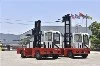
In busy factories, warehouses, or construction sites, forklifts are indispensable tools. However, due to their high unit price, high mobility, and often open operation, they are increasingly becoming targets for criminals. Theft of equipment results in direct economic losses and disruption of the logistics chain. Today, we'll discuss how to prevent forklift theft.


1. Building a Visible Defense Line
The most direct way to prevent theft is to increase the difficulty of physical movement, making it "impossible for thieves to get started":
Use specialized steering column locks or brake locks. Even if a thief enters the cab, they cannot control the vehicle's direction or release the brakes.
Develop the habit of fully lowering the forks to the ground after get off work. For models equipped with attachments, lower and lock the attachments to a fixed rack, greatly increasing the difficulty of towing.
During non-operating hours, forklifts should be parked in fenced, well-lit areas with gated surveillance, avoiding leaving them exposed on the roadside or in unattended open areas.
2. Electronic Security
With technological advancements, electronic anti-theft systems have become standard equipment on modern forklifts. Older forklifts often used a single key to open multiple machines, posing significant security risks. Now, some forklifts require both keys and card access to start; a key alone is insufficient, eliminating risk at the source.
Basic electronic security measures are also crucial. Powering off the equipment after get off work ensures the electronic anti-theft system functions effectively.
3. Real-time Tracking and Positioning
If physical security is breached, tracking becomes the final barrier.
Hidden GPS modules can be installed inside the forklift. The precise, real-time location of the forklift can be monitored via mobile device or computer, providing a clear overview of its status.
Geofencing can be used to define "safe operating zones" on the system map. If a forklift leaves this zone without permission, the system immediately sends an alarm or SMS to the administrator.
Some more advanced systems offer remote locking capabilities, allowing for remote disconnection of the hydraulic and electrical circuits in case of an emergency, shutting down the equipment.
4. Prevention is Better than Cure
Safety relies not only on equipment but also on rigorous processes:
Establish detailed records: Record the VIN (Vehicle Identification Number) and engine number of each forklift, and spray company-specific markings in concealed locations on the chassis to increase the difficulty of resale. Also, ensure the key is never left in the ignition to prevent unauthorized use. Display stickers clearly stating "GPS tracking installed" or "Electronic keypad start" on the vehicle; this psychological deterrent often discourages 80% of casual thieves.
Forklift theft prevention is never a one-size-fits-all solution; it requires comprehensive measures at multiple levels to ensure equipment security and peace of mind in production.