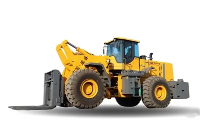
In modern construction, industry, and agriculture, telehandlers are hailed as the "Swiss Army knife of the construction site" for their exceptional flexibility and versatility. However, when this steel behemoth lifts tons of cargo to a height of ten meters and extends it forward, it is actually engaged in a rigorous struggle against a fundamental law of physics-torque balance.
1. Dynamic Center of Gravity
Unlike ordinary forklifts, the center of gravity of a telehandler is dynamic! Torque is like using a crowbar to pry open a rock; the greater the force and the longer the crowbar, the easier it is to pry. Conversely, the heavier the cargo and the longer the extended boom, the greater the "pulling force" that causes the machine to tip forward.
This is why some machines, nominally capable of lifting 4.5 tons, can only lift less than 1 ton when the boom is fully extended-this is "trading distance for weight," not because the equipment is weak, but because of the corresponding physical laws.
2. Intelligent Brain
Modern high-performance machinery no longer relies solely on operator experience but instead constructs a "digital safety fence" through integrated sensors.
The intelligent system collects data more than 35 times per second, monitoring the boom angle, telescopic length, and hydraulic cylinder pressure in real time. When the sensors detect that the center of gravity is approaching a critical point, the torque limiter (LMI) automatically intervenes, locking to prevent further extension or lifting, allowing only safe retraction.
3. Chassis and Ground Adaptability
Intelligent control alone is not enough; the telescopic boom forklift's "feet" (chassis) must also be stable. Construction sites are often uneven, and if the vehicle is tilted, lifting heavy objects will easily cause it to tip over. Some equipment that needs to lift to considerable heights and hoist heavy loads is also equipped with outriggers. The outriggers have a "pressure sensing" function: if the outriggers are not fully extended, or if the ground is too soft to support the machine, the system will directly prevent you from performing high-altitude operations. After all, without a solid foundation, even the most advanced "brain" is useless; this is the principle of "a stable chassis ensures overall stability." High-quality equipment typically features "self-leveling technology," allowing the hydraulic system to quickly adjust and keep the vehicle level regardless of uneven ground.
Whether in a busy logistics center or a complex construction site, choosing a telescopic forklift with high-performance safety features is the cornerstone of ensuring smooth project execution. By combining basic physics with modern technology, we not only improve operational efficiency but also safeguard the safety of every operator.
Safety is the foundation of construction machinery; intelligence is the future of efficient equipment. Telescopic forklifts, with their "dynamic center of gravity" balance art, "intelligent brain" precise protection, and "all-terrain chassis" solid foundation, exemplify the core strength of modern equipment.