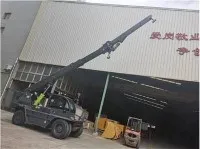
Diesel forklifts are common material handling equipment. Thanks to the powerful diesel engine and its ability to operate continuously for extended periods, they are widely used in outdoor handling and heavy-duty operations.
However, many companies often encounter a problem when purchasing diesel forklifts: what are the differences between diesel forklifts of different tonnages? How should they choose the right model?
In fact, it's not just about load capacity and operating environment; you also need to consider the type of goods you're handling and the frequency of use.
1. Light-Duty Diesel Forklifts: Suitable for Small to Medium-Sized Material Handling Operations
2-ton to 3-ton diesel forklifts are considered light-duty forklifts, mainly used for small to medium-scale material handling scenarios.
They are typically compact and easy to operate, making them suitable for logistics warehouses, building material storage facilities, and general industrial plants. If you only need to handle short distances or frequently load and unload palletized goods, this type of equipment offers the best value. Because of their compact size, the components are simple, maintenance costs are low, and fuel consumption is also low.
2. Medium-Duty Diesel Forklifts – The Versatile Choice
3- to 5-ton diesel forklifts are currently the most widely used type of equipment in the industrial sector. Balancing power performance and operational flexibility, they are suitable for many industries.
They can easily handle the handling and stacking of steel, mechanical parts, or large quantities of goods. Compared to smaller tonnage equipment, medium-duty forklifts offer stronger power output and stability, making them more suitable for long-term continuous operation. If some outdoor handling work is also required, a medium-duty diesel forklift is a versatile and highly practical choice.
3. Heavy-Duty Diesel Forklifts: Suitable for Heavy-Duty Handling Tasks
If you need to handle heavy goods such as large machinery, steel structures, or stone, then you should choose a heavy-duty diesel forklift with a capacity of 6 tons or more.
Good equipment is equipped with a powerful diesel engine and a more robust frame structure, enabling it to complete the loading, unloading, and transportation of heavy materials under complex working conditions. They are commonly found in ports, mines, the steel industry, and large construction sites.
Furthermore, they also have higher ground clearance and stronger traction, maintaining stable operation even on uneven ground or in outdoor environments.
4. Additional Factors to Consider
Besides tonnage, a comprehensive consideration is needed when making a selection. For example, the size of the work area, the size and weight of the goods, the frequency of daily use, and whether long-term continuous operation is required.
In some complex outdoor working conditions, diesel forklifts often have an advantage over electric forklifts. Their power systems are more stable, and they can continue working immediately after refueling, without the need for prolonged charging.
In the actual procurement process, the most suitable diesel forklift should be selected based on specific operational needs.